
Description
Switching power supplies, transformers and inductors all carry AC currents that tell you how a design behaves. The Tektronix P6021A current probe lets you watch those currents on an oscilloscope without breaking the circuit. It is an AC-only clamp probe that covers 120 Hz to 60 MHz, with 10.6 A RMS and 250 A peak capability.
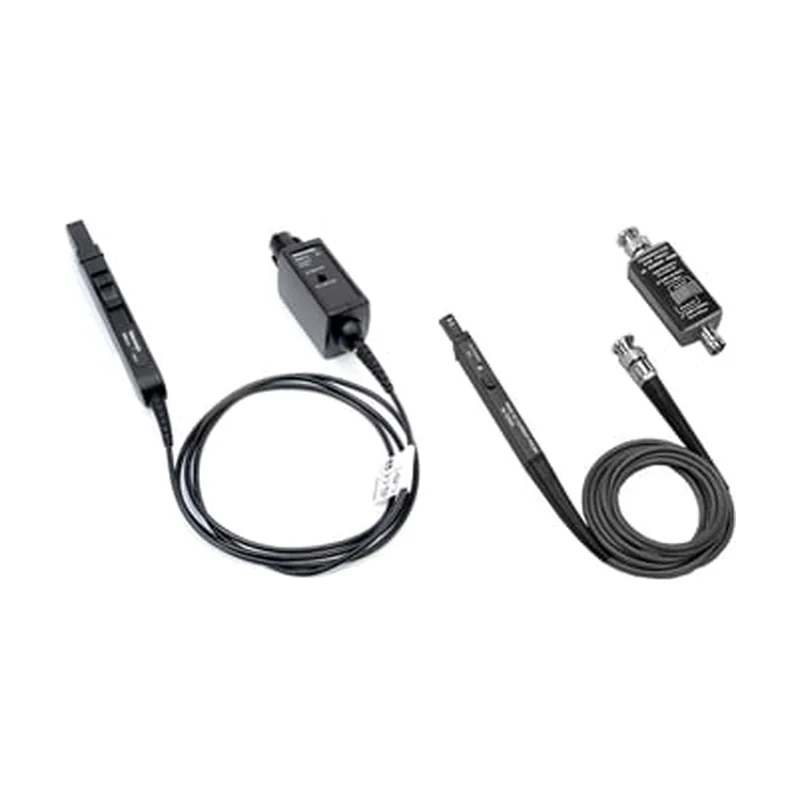
What the P6021A offers
| Specification | P6021A |
|---|---|
| Measurement mode | AC only |
| Frequency range | 120 Hz to 60 MHz |
| Current capability | 10.6 A RMS; 250 A peak |
| Minimum current | 10 mA |
| Output sensitivity | 2 or 10 mA/mV, selectable |
| Largest conductor | 5 mm diameter |
| Scope input | 1 MΩ, via BNC |
| Cable length | 1.5 m |
Where the Tektronix P6021A current probe fits
Power electronics teams use a clamp like this to study primary currents in flyback and forward converters. For example, you can view the triangle current in an output inductor and judge how close the core runs to saturation. Magnetics designers can also compare winding currents between prototype transformers. Meanwhile, test engineers can check ballast and inverter output currents on a production sample.
A note on the 120 Hz floor
Because the band starts at 120 Hz, the probe will not show a 50 Hz mains fundamental faithfully. It also cannot show DC, since it works in AC mode only. So for line-frequency or DC current, pick an AC/DC probe instead.
Setting it up
Clamp the jaw around a single conductor, not around a supply and return pair together. Then select 2 or 10 mA/mV and match the scope scaling to that setting. Also keep in mind that the 250 A peak figure is a pulse limit, not a continuous one. Above all, follow the manufacturer’s manual and ratings for voltage and derating.
Request the P6021A
Lost in HCM rents the Tektronix P6021A current probe for projects and also sells it. To begin, request a quote from Lost in HCM and list your scope model, expected current and conductor size. You can explore more oscilloscope probes or contact SMK Vietnam. For data sheets, visit Tektronix.
P6021A FAQ
How large a wire can the jaw take?
It takes conductors up to 5 mm in diameter.
What is the smallest current it can show?
The listed minimum is 10 mA, so very small signals suit the P6022 better.
Which sensitivity should I choose?
Use 2 mA/mV for small currents and 10 mA/mV for larger ones, then scale the scope to match.







Reviews
There are no reviews yet.