
Description
On a ring of flange bolts, the nearest solid stop is often the next nut over. The Snap-on MTMB2200 torque multiplier puts that nut to work. Its long reaction bar reaches across to a neighboring nut or a frame member, so the gearbox stays steady while you pull. Behind the bar sits a gearbox with a 1/2 in square input and a 1 in square output, good for up to 2,200 ft-lb.
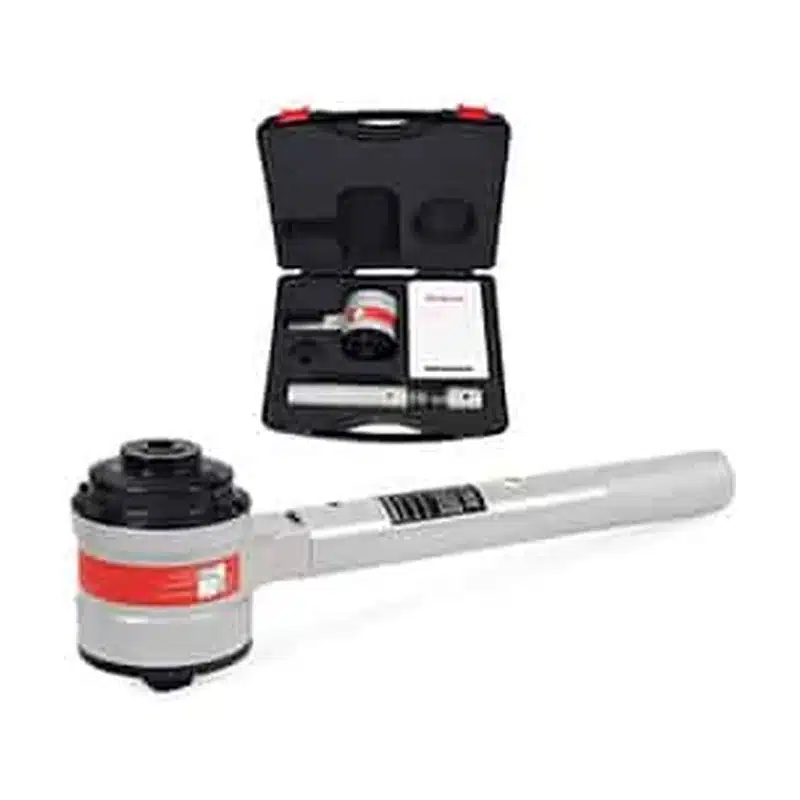
What bar style means in practice
Every manual multiplier must push against something while it turns the bolt. Compact units use a short foot, while plate units use a wide plate. A bar style unit such as the MTMB2200, by contrast, uses a long arm. That reach helps on round bolt patterns, because the bar can rest on the next fastener without extra fixtures. It also spreads the load away from the joint you are tightening.
Before you start, check that the bar has clear contact on a strong surface. Then confirm it cannot slip off as the load builds.
Bolt patterns that suit the Snap-on MTMB2200 torque multiplier
- Pipe and valve flanges on process skids, refineries and gas plants.
- Wind turbine tower and yaw ring bolts during service visits.
- Heat exchanger and pressure vessel covers in chemical plants.
- Large slewing bearings on cranes and excavators.
In each case, the joint value should sit within the 2,200 ft-lb rating. If a spec arrives in N·m, convert it first. For example, 2,200 ft-lb works out to roughly 2,980 N·m.
Tightening a flange in passes
Large flanges seal best when the load rises evenly around the ring. So most procedures use a star or cross pattern over several passes. A common plan looks like this:
- Snug every nut by hand first.
- Run a first pass at about a third of the final value.
- Then run a second pass at about two thirds.
- Finish with a full pass and one check round.
Always follow your own site procedure if it differs. In addition, move the MTMB2200 reaction bar to a fresh nut each time, so it never pushes on a loose one.
Looking after the bar and gears
Wipe the bar and drive squares after each job, and look for cracks or bending on the reaction arm. Seized nuts call for a breaker bar instead, since sudden shock can chip gear teeth. Also keep a record of the input wrench used with it. Both tools affect the final value, so plan an independent calibration check for each at a fixed interval.
Buying the Snap-on MTMB2200 torque multiplier through Lost in HCM
Our listing points to Lost in HCM, the partner that supplies and quotes this bar style unit. Send your flange sizes and quantity when you request a quote from Lost in HCM, and they will confirm price and delivery. Related torque multipliers sit in the same category, while snapon.com covers the full Snap-on range. For sizing help, contact SMK Vietnam.
Buyer FAQ for the MTMB2200
Where should the reaction bar rest?
Rest it on a strong, fixed point, such as an adjacent nut, a lug or a frame member. Never hold it by hand.
Can I drive it with the 1/2 in click wrench I already own?
Yes. The Snap-on MTMB2200 torque multiplier works with any 1/2 in wrench that covers the input value you calculate from the label ratio.
Does it need a 1 in socket?
Yes. The output is a 1 in square drive, so use heavy-duty 1 in drive sockets or a suitable adapter.








Reviews
There are no reviews yet.