
Description
Datasheet values for a capacitor, inductor or resonator rarely match what the part does on your board. So the Keysight E4990A impedance analyzer shows the difference. It measures from 20 Hz up to 120 MHz, depending on the option, with 0.045% typical basic accuracy.
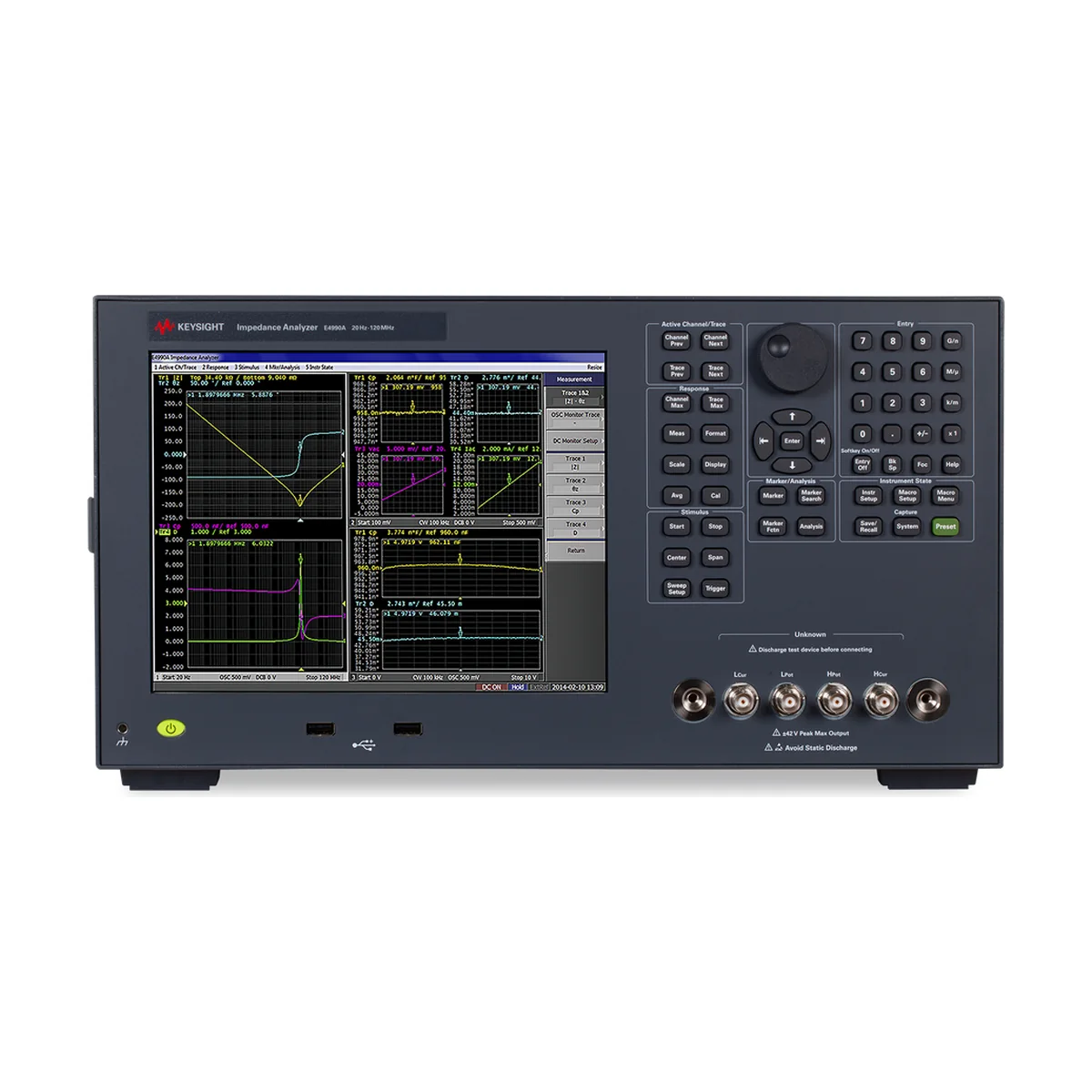
Measuring parts under real conditions
The instrument has built-in DC bias of up to plus or minus 40 V and plus or minus 100 mA. So you can stress a component with its working voltage while the sweep runs. It uses a four-terminal pair connection, and a 10.4-inch color touchscreen displays the results.
However, typical accuracy is not a guarantee for every setup. The fixture, the cable length and the calibration method all shift the final uncertainty. Therefore, plan the full measurement chain, not only the analyzer.
Interpreting the sweep
Equivalent-circuit analysis turns a curve into resistance, capacitance and inductance values you can compare. Also, limit testing flags parts that fall outside a window. Finally, flexible sweeps let you zoom in on a resonance. As a result, a technician can judge a batch of parts without exporting every curve.
Where the Keysight E4990A impedance analyzer fits
- Characterizing parts such as capacitors, inductors and resonators in R&D.
- Evaluating dielectric materials and semiconductor devices.
- Modeling equivalent circuits, then checking quality factor.
- Incoming inspection and production measurement.
Rental or purchase through Lost in HCM
Rent the Keysight E4990A impedance analyzer for a material study or a qualification run. Buy instead when incoming inspection needs it every week. Lost in HCM quotes both, while SMK Vietnam only lists the product. For a lower-frequency LCR job, compare it with a smaller meter before you decide. Start with a request: request a quote from Lost in HCM with your frequency range, fixture type and bias needs. You can also read about the Keysight website, browse impedance and LCR meter rentals, or contact SMK Vietnam.
E4990A questions
Which frequency option does the E4990A need?
The analyzer starts at 20 Hz and tops out at 10, 20, 30, 50 or 120 MHz, depending on the option. Tell Lost in HCM your highest test frequency, so the quote will match it.
What does the built-in DC bias do?
It applies up to plus or minus 40 V and 100 mA while you measure. That lets you see how a capacitor or inductor behaves under operating conditions.
Are test fixtures included?
Not automatically, because fixtures, adapters, bias accessories and calibration standards depend on the configuration, so list them in your request.








Reviews
There are no reviews yet.